You live in the country side and are very likely the mistress of a large household. You have to supervise a number of daily chores and do the most demanding tasks yourself: You probably are a good cook and pride yourself on your neat house and productive garden, as well as your healthy and well-clothed children.

Church service every sunday is the only social function you attend, and fashion is a distant and mysterious thing to you: To dress neat and proper and befitting one’s station is all the renown you will likely ever reach in the world of fashion, and more than enough to make you justly proud.

Below I have listed some garments that will make a nice and flexible wardrobe (1795 - 1815), the absolute minimum for a weekend is in black, the optional extras for more variety or longer events are in red.

Plain but Neat: A Rural Woman’s Clothes

  • two chemises or shifts of sturdy linen
  • another chemise to allow the others time to dry
  • one pair of short stays
  • a pocket to tie around your waist for your personal belongings
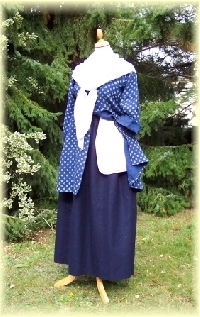
  • one bed gown of printed cotton or linen in a muted colour (this is NOT a night-time garment, nor is it worn in bed!)
  • a second bed gown or a fitted caraco jacket
  • one woolen waist-petticoat
  • a linen waist-petticoat for hot or very cold weather
  • one generously sized, serviceable apron to protect your clothes
  • a pretty apron of finer fabric (print or stripe does just fine)
  • a modest neckerchief (absolutely neccessary for a proper appearance)
  • a second neckerchief (as the neckerchief should always be worn scrupulously clean)
  • a cap of fine linen, covering your hair
  • a fashionable (but still very modest) cap for sundays
  • a dress not too old-fashioned for sunday best (e.g. a trainless round gown of coloured calico)
  • one pair of knit stockings
  • a second pair of stockings (if you are over-nice)
  • one pair of sturdy leather shoes with buckles
  • a pair of wooden clogs for wet weather
  • one warm woollen hooded cape or cloak
  • a bonnet to cover your cap when you go “to town” (i.e. leave your house and garden)

Playing the lower classes is in no way easier than portraying a more well-to-do character: Sources are often difficult to find, plus you need some real skills like cooking with an open fire, chopping wood etc.

On the other hand you really get to do things, and your clothes must reflect this in cut and material. They are generally very comfortable and easy to wear, whereas the fashionable dresses with their small backs can be very restrictive. You do not have to fear getting your clothes dirty, they will anyway, and are in fact intended to, like the apron.

But beware, buying the reserve printed linens, sturdy wool cloth and buckled shoes is in no way any less expensive than outfitting a country gentleman’s daugther. The more rustic garments are a lot easier to make on your own, though, and that will save a lot of money.

When portraying a proper housewife, you should wear a cap and neckerchief at all times, except in bed. It is a good idea to create all the clothes in matching colours, so that they can be freely interchanged without producing colour clashes, as this gives the wardrobe considerable variety.

woolen petticoat, bed gown and neckerchief, note the pocket peeping from under the bed gown

back

Text von/by Ann-Dorothee Schlüter
Bilder/pictures ©
www.ArtsetMetiers.de.