You do have social obligations, but they are an exception rather than the rule in your daily life. You do have servants, but you cannot afford to idle away your days getting accomplished on the harp...

You should have a refined but not over-fine wardrobe, with some nice modish touches. It should enable you to attend dinners and dances in style, and allow you to take an active part in the daily routine of housekeeping as well. You will also need walking dresses and shoes, since you are very likely not able to use a carriage for all your ways.

Below I have listed some garments that will make a nice and flexible wardrobe (1795 - 1805), the absolute minimum for a weekend is in black, the optional extras for more variety or longer events are in red.

Wardrobe of a Gentleman’s Daughter

  • two fine chemises (or shifts) of mid-calf length or slightly longer
  • one pair of short stays (unneccessary if your dresses have inbuild bodices and you have small breasts)
  • one pocket to tie around your waist (dresses should have pocket slits accordingly)
  • one coloured petticoat (for variety, usually chemise and stays are sufficient)
  • two pairs of stockings, one with coloured clocks, plus one pair of garters
  • one apron of fine linen or calico, to keep your dress clean in case you have to get your hands dirty
  • one un-trained unobstrusively coloured calico dress with detacheable long sleeves (sleeves for morning wear)
  • one muslin dress, probably trained, but also with detacheable sleeves, in white or creme
  • one chemisette (also for morning wear)
  • another different chemisette
  • one peplos with ultra-short sleeves (to give your dress another look, and you some warmth)
  • one sleeveless spencer (still more variety)
  • one silken sash (a very inexpensive way to give your dress yet another stylish new look)
  • one cashmir shawl (for indoor warmth and decoration)
  • a trained robe with elbow-length sleeves
  • one pair of long white or beige gloves (preferrably of cotton, as they will get dirty, trust me)
  • an extra pair of gloves for afternoon or outdoor wear, probably shorter
  • one reticule to carry your neccessities
  • one morning cap (so that you can have breakfast before getting your hair dressed)
  • one silkscarf, silk flowers or a feather (for evening headwear)
  • one overgarment such as a warm spencer, cloak or redingote
  • one ourdoor headdress such as a bonnet or hat
  • two pairs of shoes, one white for indoor and evening wear, and one dark for day and outdoor wear (white leather is fine for both day and formal wear, but it cleans much better than satin!)
  • satin dancing slippers or coloured shoes

As a rule you should keep the essentials (dresses, gloves, stockings, shoes) as plain as possible, so that accessoires of any colour will match and complement them. If you have to have accessoires of different colours, make sure that accessoires which might be worn together (e.g. cashmir shawl, reticule and peplos, or reticule and silk sash) are of matching colours. Indeed it would be best to have all accessoires in different shades of the same colour.
Morning dress should have long sleeves and was usually worn with the neckline filled with a chemisette or kerchief (you may also use the silk scarf), head-dress should be rather plain, an elegant cap works very well. Indoors no gloves were worn until dinner.
As the day progresses, dress may become more elaborate, add for example an elegantly tailored sleeveless spencer or a peplos. If you go outside in foul weather, wear a dress without train, since you will most likely have no possibility of getting it cleaned during the event, which means one dress less to wear.
Formal dress (dinner, evening, dancing, ball) should have short sleeves and long gloves, low necklines with tasteful jewelry (a strand of pearls does very well) and smart accessoires such as reticule, peplos, spencer, or even a robe. Try different hair styles with either flowers, feathers or scarves (or indeed all of those).
Make your outdoor over-garment (whether it be cloak, spencer or redingote) as warm as possible, as you can use your cashmir shawl in warmer weather when less protection is needed. After all, outdoor overgarments are not for decoration, but to protect you from the cold.

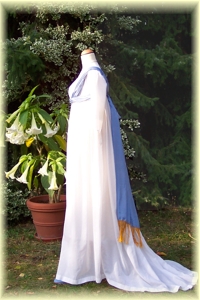
fringed sash of powdery blue silk and matching shoes, worn with a plain white round gown

back

Text von/by Ann-Dorothee Schlüter
Bilder/pictures ©
www.ArtsetMetiers.de.